Scaling up garlic: what breaks first
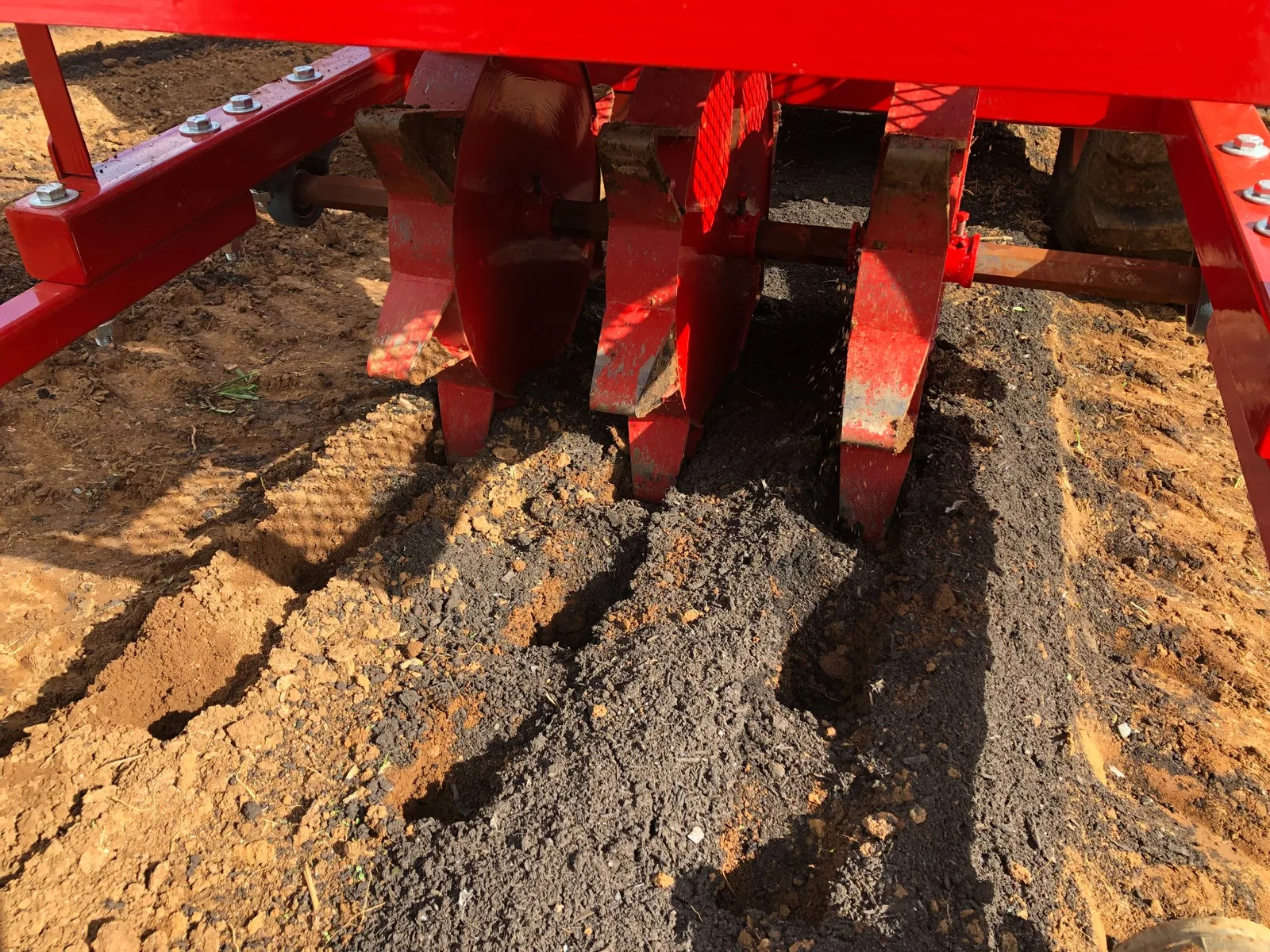
Short answer: four things break as garlic acreage grows, and they break in order. Planting labour goes first, usually between one and three acres. Harvest goes second. Curing space goes third and is the one nobody plans for. Grading and packing goes fourth. Solving them out of order is how growers end up with a machine they did not need and a crop rotting in a shed.
Garlic scales badly for a specific reason: almost every operation is per-clove or per-bulb. Field work like tillage, spraying and mulching scales roughly with area, so doubling acreage costs about double. Planting, lifting, trimming and grading scale with the number of bulbs, and none of them get cheaper per unit at any size until you change the method entirely.
Where the walls are
At the common 6″ × 6″ spacing, an acre is 174,240 cloves. That number does most of the explaining on this page.
| Acres | Cloves at 6″ × 6″ |
|---|---|
| 1 | 174,240 |
| 3 | 522,720 |
| 5 | 871,200 |
| 10 | 1,742,400 |
Every one of those has to be picked up and placed root-down in October, then lifted, trimmed and graded the following summer. Ten acres is not ten times harder than one acre in a linear-feeling way. It is 1.74 million individual handlings, four times over.
Wall one: planting labour
This is the wall almost everyone hits first, and it hits inside a two-to-four week window in October when the rest of the farm is also demanding attention.
Hand-planting rates vary enormously depending on whether you are counting furrow opening, placement and covering, or just dropping cloves into an open trench. Realistically, counting the whole job, most crews land somewhere between 400 and 1,000 cloves per person-hour, and the honest figure for your farm is the one you measure yourself.
At 700 an hour, one acre is roughly 250 labour-hours. Three acres is 750. Five acres is 1,245 — which is a crew of six working full eight-hour days for most of the month, in cold soil, on their knees.
The binding constraint is rarely the wage bill. It is that those six people do not exist in most townships in October at any price, and the ones who do exist do not come back the following year.
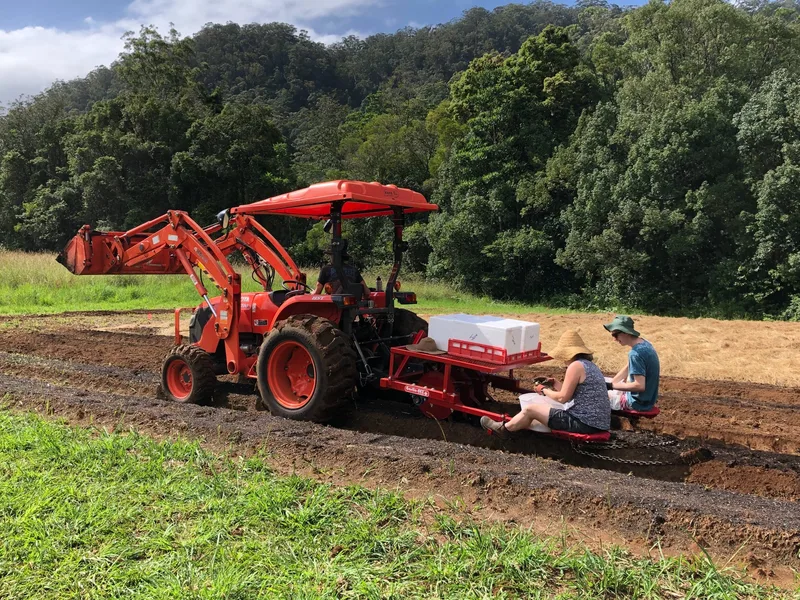
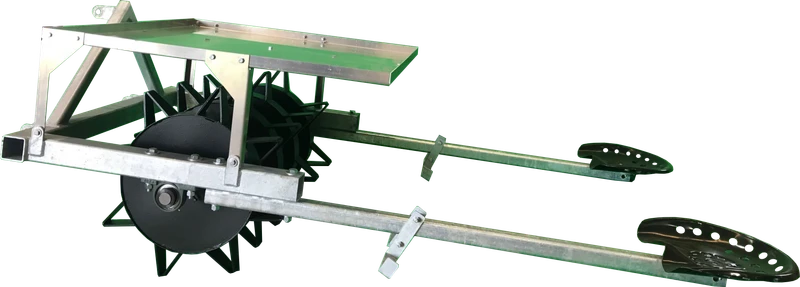
A ride-on planter changes the shape of that problem rather than the total hours. Two people ride the PL-22, each placing 600 to 800 cloves an hour, so the machine plants 1,200 to 1,600 an hour and the labour-hours per acre look similar to a fast hand crew. What changes is that it is two people instead of six, they are seated so the rate holds at four in the afternoon, and every clove goes in root-down.
Now do the calendar arithmetic honestly, because this is where scaling gets real:
| Acres | Cloves at 6″ × 6″ | Hours for one machine at 1,400/hr | Eight-hour days |
|---|---|---|---|
| 1 | 174,240 | 124 | 16 |
| 3 | 522,720 | 373 | 47 |
| 5 | 871,200 | 622 | 78 |
| 10 | 1,742,400 | 1,244 | 156 |
Sixteen days for an acre fits an October. Forty-seven days for three acres does not.
So above roughly two or three acres at close spacing, one machine on one shift is not the answer either. The realistic levers are running more than one machine, running longer days with rotating riders, or opening your spacing — at 8″ × 8″ an acre is 98,010 cloves, which is 70 machine-hours instead of 124. Most growers use some of all three. Our own view, stated on the FAQ, is that the PL-22 suits roughly one to twenty acres, and that past twenty to thirty acres you should be looking at a fully automated planter, because no realistic crew can ride fast enough to get the crop in.
Under about an acre, do not buy a planter. It is one hard week by hand and the machine will take many seasons to pay back. The hand-planting comparison shows the break-even and the cost calculator runs it on your own numbers, defaulting to break-even rather than to a figure that flatters us.
Wall two: harvest
Harvest breaks second, usually around the same acreage, and it breaks in two separate places.
Getting bulbs out of the ground. Pulling puts all the force through the neck. In light sand plants often come clean; in anything firmer a share of the crop snaps off and stays in the ground, and what does come out is bruised in ways you find in November. A blade run under the bed loosens the root mass so plants lift with almost no force. This is the cheapest wall to solve, because it is one tractor pass per bed rather than per-bulb work — the UC-36 and UC-48 run 6–8″ below the bulb and need at least 40 HP, and they mount to the PL-22 frame in place of the planting wheels.
Moving bulbs from the field to the curing space. This is per-bulb and it does not mechanise on a small farm. Ten acres is a lot of totes, a lot of trips, and a wagon you probably do not own yet. Budget for handling, not just for lifting.
Wall three: curing space — the one people forget
Here is the wall that surprises growers, because it is invisible until the day the crop comes out of the ground.
Garlic cures in a single layer or hung, in shade, with air moving across every bulb. It cannot be piled. That means your curing capacity is a surface area problem, and surface area scales exactly with bulb count.
Work out your own number before you plant the extra acres:
- Take your actual yield per acre in bulbs — count a measured length of row from last year, do not guess.
- Count how many bulbs your racking holds per square foot of surface, single layer with air between them.
- Divide.
As an illustration only, with an assumed 12 bulbs per square foot of rack, one acre at 6″ × 6″ needs on the order of 14,000 square feet of curing surface. On five-tier racking that is still a couple of thousand square feet of floor — per acre. Your own numbers will differ, and that is the point: run them.
This is why growers end up with twelve thousand pounds of garlic and nowhere to hang it. Planting capacity can be bought in a fortnight; curing space is a building. If you are planning to double your acreage, sort the curing space out in the winter before you plant, not in the July after. What good and bad curing looks like is in curing and storing garlic.
And to be blunt: we do not sell anything that helps here. No machine on this site cures garlic. It is racks, shade, fans and floor space, and it is the wall we cannot help you with.
Wall four: grading, trimming and packing
The last wall is per-bulb again, and it arrives in August when the crop is cured. Every bulb gets its neck and roots trimmed, gets brushed off, gets sized, and gets sorted into seed, market grade and culls.
It is slower than people expect and it competes with market days. Growers usually solve it with a longer season of part-time labour rather than equipment, because a bulb destined for a farmers’ market table has to be handled by a person anyway.
Grading is also where your next crop is decided, since your seed comes out of this pass — see choosing seed garlic.
The order matters
If you take one thing from this page: solve the walls in the order they arrive, and never buy the machine for wall two before you have space for wall three.
A planter that lets you put ten acres in the ground is a liability if you have curing space for three. The most expensive scaling mistake in garlic is not buying the wrong equipment. It is successfully planting a crop you cannot cure.
Keep reading
-
 When to plant garlic in Ontario: a fall timeline Roughly two to four weeks before the ground freezes — mid-October to early November across most of the province. Here is the whole season, week by week.
 -
 Planting onion sets with a garlic planter Sets and cloves are the same problem: a small bulb, root plate down, at a spacing. We make a dedicated onion wheel. Seed and transplants are a different machine entirely.
 - Planting tulips, hops and ginseng with a garlic planter A garlic planter is really a bulb, rhizome and large-seed planter. Six confirmed crops beyond garlic — plus the honest note that garlic is what it is optimised for.