Garlic Planter vs. Hand Planting: The Real Numbers
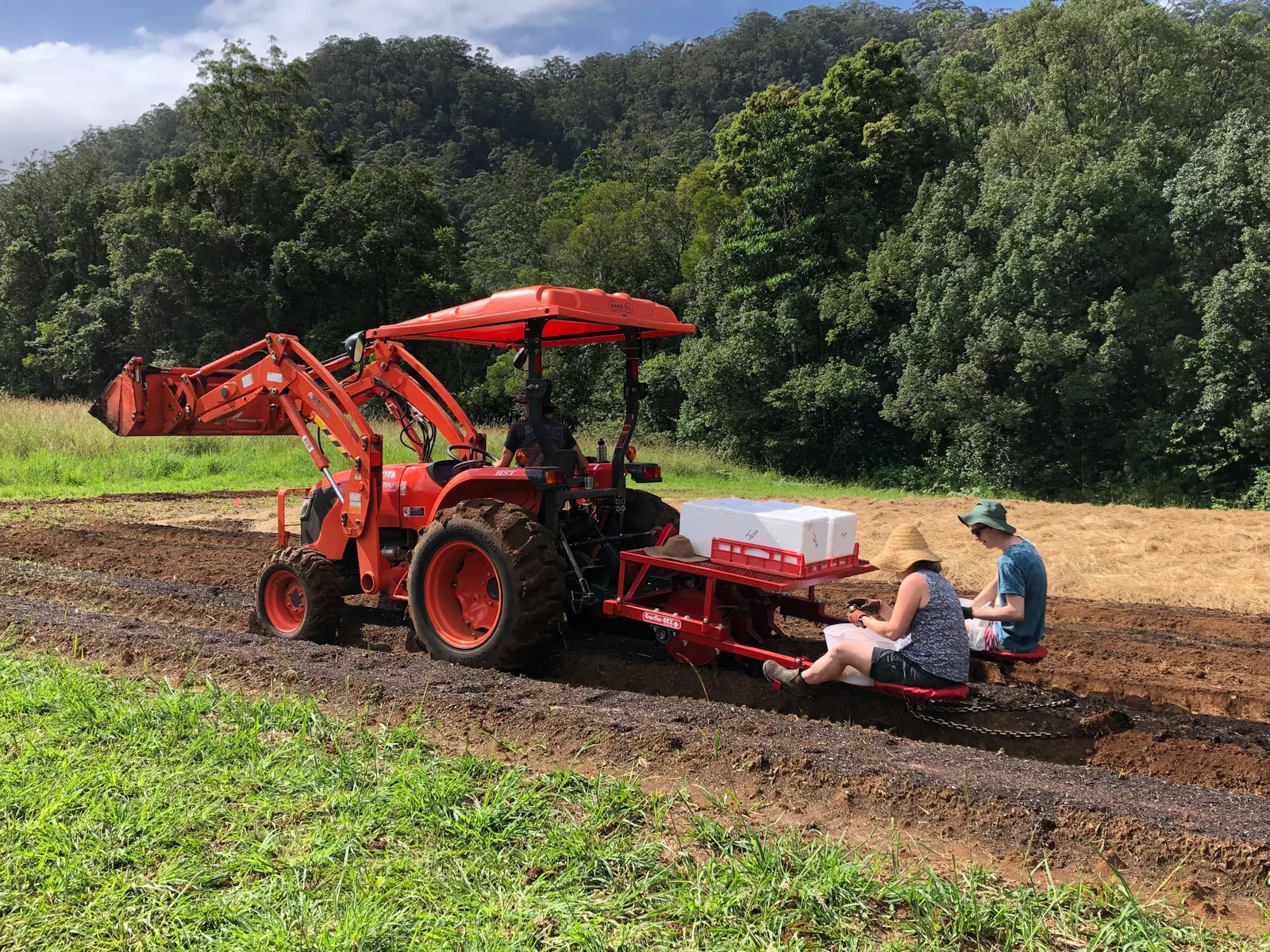
Most articles you will find on this question are written by people selling planters. This one is too — we build them. So we are going to show the arithmetic and let you check it.
Start with how many cloves you are actually planting
Garlic spacing is usually given in inches, which makes the per-acre number non-obvious. Here it is:
| Spacing | Cloves per acre |
|---|---|
| 4″ × 6″ | 261,360 |
| 6″ × 6″ | 174,240 |
| 6″ × 8″ | 130,680 |
| 8″ × 8″ | 98,010 |
(An acre is 6,272,640 square inches. Divide by your spacing.)
At the common 6″ × 6″, three acres is 522,720 cloves. Every one of them has to be picked up and put in the ground root-end down.
What hand-planting costs — and why nobody agrees on the number
This is where most comparisons quietly cheat. Published hand-planting rates are all over the place, from about 400 cloves per person-hour to over 1,000, and the reason is that they are measuring different jobs. Dropping cloves into a furrow somebody else opened is fast. Opening the trench, placing the clove root-down, and covering it — all day, kneeling, in cold October soil — is not.
So we are not going to hand you a number. Here is the arithmetic at several rates, for three acres at 6″ × 6″ and $18 an hour all-in:
| Hand rate | Labour-hours | Labour cost |
|---|---|---|
| 400/hr | 1,307 | $23,522 |
| 500/hr | 1,045 | $18,818 |
| 600/hr | 871 | $15,682 |
| 700/hr | 747 | $13,441 |
| 1,000/hr | 523 | $9,409 |
What a planter changes — and what it doesn’t
Here is the part most equipment marketing skips.
A ride-on planter does not multiply one person’s output the way a combine does. Two people ride the PL-22, and each places 600 to 800 cloves an hour. That is the whole job — the machine opens the furrow, meters the spacing and closes the row, so it is a fair comparison against hand-planting counted the same way.
Call it 700 per rider-hour. Three acres takes 747 labour-hours, or $13,441.
Now put that next to the table above, and the honest conclusion falls out:
Break-even is around 700 cloves per person-hour by hand. If your crew is slower than that, the machine pays — $2,240 at 600/hr, $5,377 at 500/hr, $10,081 at 400/hr. If your crew is genuinely faster than 700 an hour placing cloves root-down and covering them, a planter will not cut your labour bill, and you should not buy one for that reason.
We would rather tell you that than have you work it out after the cheque clears.
So why do growers buy them?
The four reasons that actually drive the decision
1. You need fewer people, not fewer hours
The constraint in October is rarely the wage bill. It is finding people who will kneel in a field for two weeks. Two riders on a machine is a fundamentally easier crew to assemble than six people on their knees, and that is worth more than the arithmetic shows — because in a lot of townships those other four simply do not exist at any price.
2. The rate holds all day
Hand-planting rates are quoted from the first hour, not the sixth. Seated operators sustain their rate through the afternoon, which means the schedule you planned is the schedule you get — and 600–800 an hour at four o’clock beats a number that was only ever true at nine.
3. Orientation
A clove planted sideways or inverted still grows — it grows a bent neck and an undersized, misshapen bulb that you pay to sort out at grading, ten months later. Fully automated cup and belt planters cannot control orientation; that is the trade they make for speed. A ride-on planter with a person placing each clove has no double-drops, no skips and no upside-down cloves. This cost never appears in a planting-day calculation and it is real money.
4. Your crew comes back
Hand-planting garlic is the job people quit over.
When it does not make sense
Under about an acre, do not buy a planter. One acre at 6″ × 6″ is 174,240 cloves — roughly 250 labour-hours at 700 an hour, or 175 at 1,000. Real work, but one crew-week, and the machine will take many seasons to pay back at that scale.
If your bottleneck is land, seed stock or market access rather than planting labour, a planter does not solve your problem.
And if you plant into plastic mulch on a bed layout the machine cannot be configured for, find that out before you buy, not after.
Run your own numbers
Our labour cost calculator takes your acreage, spacing, labour rate and — most importantly — your own observed hand-planting rate, and does this arithmetic for your farm. It defaults to break-even rather than to a number that flatters us. If the answer says a planter does not pay for you, believe it.
If it does, the PL-22 is here — and you can call Doug on 519-379-6210 and ask him anything on this page.
Keep reading
-
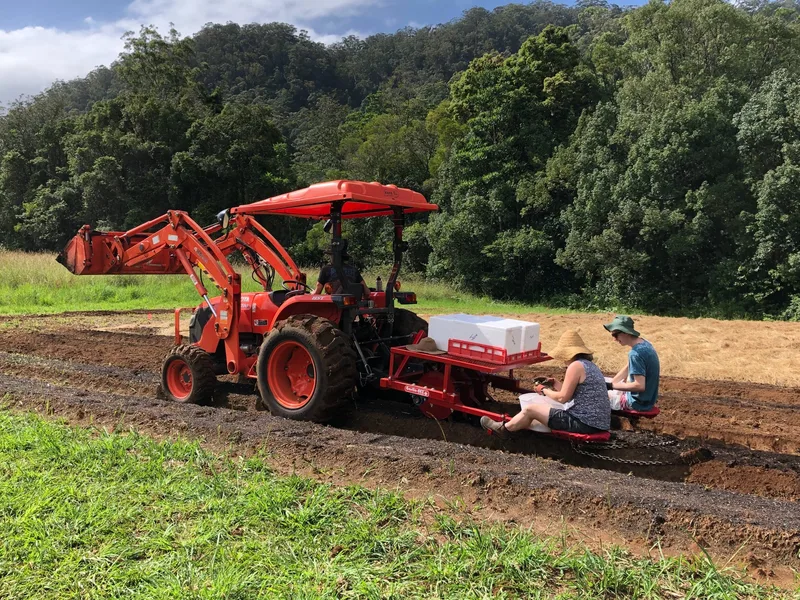 When to plant garlic in Ontario: a fall timeline Roughly two to four weeks before the ground freezes — mid-October to early November across most of the province. Here is the whole season, week by week.
 -
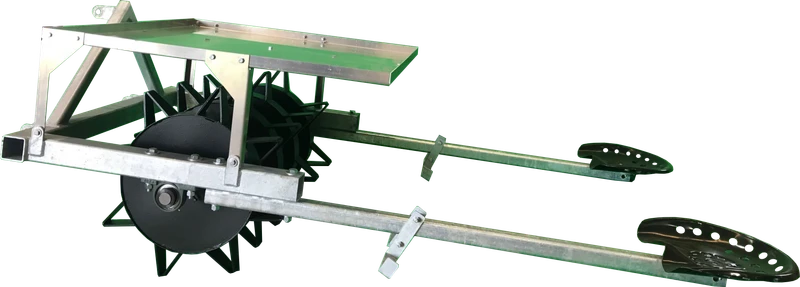 Planting onion sets with a garlic planter Sets and cloves are the same problem: a small bulb, root plate down, at a spacing. We make a dedicated onion wheel. Seed and transplants are a different machine entirely.
 - Planting tulips, hops and ginseng with a garlic planter A garlic planter is really a bulb, rhizome and large-seed planter. Six confirmed crops beyond garlic — plus the honest note that garlic is what it is optimised for.