How to cure and store garlic
Short answer: hang or rack the whole plants in a shaded, dry, well-ventilated space with air moving across them, and leave them three to four weeks. It is cured when the neck is dry all the way through and the outer wrappers are papery. Airflow matters more than temperature, and direct sun ruins it.
Curing is where a good crop gets thrown away. The harvest is the visible work and the curing is the invisible work, and a grower who nails the harvest window and then stacks wet bulbs in a closed shed will lose more garlic in August than they would have lost by digging a week late.
What curing actually does
Two things, and they are worth separating because they fail separately.
It seals the neck. The neck is the band of tissue between the top of the bulb and the base of the leaves. Straight out of the ground it is thick, green and full of water, and it is a direct route into the bulb for every rot organism in your shed. Curing dries it down to a hard, closed cork. Squeeze a cured neck and it should feel like a dry twig, not a straw with give in it.
It dries the wrappers. The outer leaf bases that wrap the bulb go from moist and leathery to dry and papery. Those wrappers are what keeps dirt off the cloves, keeps moisture in and pathogens out, and lets the bulb sit for months.
What curing does not do is dry the cloves. Inside their skins the cloves stay firm and juicy. If your cloves are shrivelling, the environment is too hot or too dry, and you have gone from curing to dehydrating.
The four conditions
| Condition | Target | Why |
|---|---|---|
| Airflow | Constant air movement across every bulb | The one variable that decides the outcome |
| Light | Full shade | Sun bleaches and sunburns wrappers, and burnt wrappers split |
| Temperature | Warm but not hot — a shaded barn in July is right | Too hot cooks the cloves, too cold stalls drying |
| Humidity | Moderate and falling | Damp air stalls the neck; bone-dry air shrivels cloves |
If you get only one of these right, make it airflow. Garlic cures fine over a wide range of temperature and humidity as long as air keeps moving. It cures badly in still air at any temperature.
Practically, that means:
- Single layer or hung, never piled. A pile of garlic has an interior with no air in it. That interior is where mould starts.
- Fans. Box fans in a barn, a fan at each end of a hoop shelter, anything that keeps the air turning over. This is the cheapest yield protection you will ever buy.
- Space between bunches. If bundles are touching, the touching faces are not curing.
- Leave the tops on. Whole plants cure better than trimmed bulbs, because the drying neck pulls moisture up out of the bulb rather than trapping it. Trim after curing, not before.
- Do not wash. Ever, before curing. Brush the loose dirt off after curing and peel a dirty outer wrapper away if you need to clean up a bulb for market.
How long
Three to four weeks is the normal range. Big bulbs, thick necks, a cool damp August, or a crop harvested slightly early all push it towards four weeks and beyond. A hot dry spell with good fans can finish it in under three.
Do not go by the calendar. Test it:
- The neck. Squeeze it just above the bulb. Dry and hard right through, with no soft or cool core. This is the definitive test.
- The wrappers. They rustle. They should be papery, not leathery.
- The cut test. Cut a neck across with secateurs. A cured neck cuts dry and shows a uniform dry cross-section. Any green or damp centre and it is not done.
Only when all three pass do you trim, grade and move it into storage.
What good and bad storage look like
Once cured and trimmed, garlic wants cool, dry and dark, with air still able to move around it. Mesh bags, slatted crates, open bins. Not sealed containers, not plastic bags, not a cellar with condensation on the walls.
The two things that end storage life are moisture and the wrong temperature band.
| Storage | What happens |
|---|---|
| Cool and dry, good air | Months. This is the target. |
| Damp | Mould on the wrappers, then rot at the basal plate |
| Warm | Shrivelling, then early sprouting |
| Fridge temperature | Triggers sprouting. The worst place for eating garlic |
| Sealed plastic | Traps respired moisture. Fastest way to lose a crop |
The refrigerator one surprises people. Cold, damp fridge conditions are close to what a clove interprets as winter, and a bulb that thinks winter is over starts sprouting. For kitchen garlic, a dry pantry shelf beats a fridge every time.
Seed garlic stores differently from eating garlic
This matters if you are saving your own planting stock, and it is the place growers most often use one storage room for two jobs that want different things.
Eating garlic should stay dormant as long as possible. You want it not to sprout, not to shrivel and not to rot, so you are optimising for shelf life.
Seed garlic is going back in the ground in October, and a certain amount of cool conditioning before planting is normal and useful — it is part of what tells the clove to divide properly next season. You are not trying to hold seed garlic to March. You are holding it two or three months and then planting it.
Practically:
- Store seed stock separately and label it, so nobody sells your best bulbs at the Saturday market in September.
- Keep seed a little cooler than eating stock if you can, and never warm and dry enough to shrivel — a dehydrated clove has lost the reserves next year’s bulb is built from.
- Crack seed bulbs one to two days before planting, not weeks ahead. An exposed basal plate dries out, and that is vigour you paid for.
- Grade seed at trimming while the crop is in front of you. Which bulbs you keep is covered in choosing seed garlic.
Where equipment doesn’t help
This is an equipment company’s website, so it is worth saying plainly: we do not make anything that cures garlic, and there is no machine on this site that improves any part of this page. Curing is racks, shade, fans and patience. The best money you can spend on it is on airflow and on enough hanging space, and neither comes from us.
The one place equipment touches curing is upstream. Bulbs that come out of the ground with torn wrappers, snapped necks and bruised basal plates cure worse and store worse, because every wound is a way in. Lifting the row before you pull it — undercutting on acreage, a garden fork on a garden — is the part of curing that happens in July.
And the part before that is harvesting at the right moment. No curing regime rescues a bulb that was already split when it came out of the ground.
Keep reading
-
 When to plant garlic in Ontario: a fall timeline Roughly two to four weeks before the ground freezes — mid-October to early November across most of the province. Here is the whole season, week by week.
 -
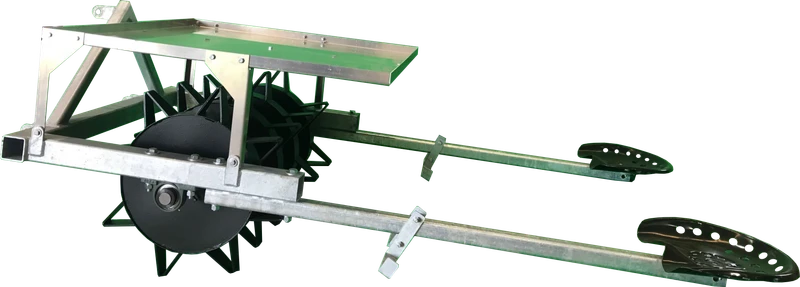 Planting onion sets with a garlic planter Sets and cloves are the same problem: a small bulb, root plate down, at a spacing. We make a dedicated onion wheel. Seed and transplants are a different machine entirely.
 - Planting tulips, hops and ginseng with a garlic planter A garlic planter is really a bulb, rhizome and large-seed planter. Six confirmed crops beyond garlic — plus the honest note that garlic is what it is optimised for.