When to harvest garlic: read the leaves, not the calendar
Short answer: harvest when the bottom third to half of the leaves have browned off and four to six healthy green leaves are still standing on top. In most of Ontario and the northern US that lands somewhere between mid-July and early August, but the date is a consequence, not the signal.
Every year somebody digs their whole crop on the day the neighbour dug theirs, or on the date they wrote down last July, and gets a field of half-formed bulbs or a field of burst ones. The plant will tell you. You have to go and look at it.
Why days-from-planting is a bad rule
Garlic sits in the ground for roughly nine months. Across that span, the things that actually set maturity date all move independently of the calendar:
- Variety. Some Rocamboles are done a full two weeks before a Porcelain in the same field.
- Planting date and depth. A crop that went in three weeks late does not always finish three weeks late — but it does not finish on time either.
- Spring heat. A warm, dry June pushes the crop to maturity fast. A cool wet one stretches it out.
- Soil and fertility. Nitrogen still available in late June keeps leaves green past the point where the bulb has stopped filling.
Two varieties, planted the same day, in the same soil, can be ten days apart. One date cannot cover both. Counting leaves handles all of it, because the leaves are reacting to the same conditions the bulb is.
What a leaf actually is
This is the part that makes the rule make sense.
Each leaf on a garlic plant runs down the pseudostem and wraps the bulb. The leaves you see above ground and the wrapper layers you see on a cured bulb are the same tissue. When a leaf dies back, the wrapper it corresponds to breaks down in the soil.
So counting dead leaves is not a vague ripeness proxy. It is a direct count of how many wrappers you have already lost. A bulb with four browned-off leaves has burned through four of its outer layers. Wrappers are what hold the bulb together in storage, keep it clean, and make it saleable, and they are a finite budget that starts being spent the moment senescence begins.
That is the whole trade. Leave the crop longer and the bulb gets bigger; leave it longer and you have fewer wrappers protecting it.
| Leaf state | What it means | What to do |
|---|---|---|
| All leaves green | Bulb still sizing, cloves may not be divided | Wait. Start checking in a week. |
| 1–2 lower leaves brown | Senescence has started | Dig a test bulb. Note the date. |
| Bottom third to half brown, 4–6 green | Cloves filled, wrappers intact | Harvest window. |
| Only 2–3 green leaves left | Wrappers thin, bulbs starting to open | Get it out now. |
| Tops flat, necks soft | Wrappers gone, cloves splitting | Late. Sort hard, sell fast. |
Dig a test bulb. Actually dig one.
The leaf count tells you when to look. The bulb tells you whether to go.
Pull — or better, loosen and lift — two or three plants from different parts of the field, including your worst-drained corner and your best ground. Then look at them.
What ready looks like:
- Cloves are fully differentiated, and you can see their outlines pressing through the wrappers when you look at the bulb from the side.
- The wrapper layers are intact all the way around, with no splits at the shoulder.
- The bulb fills your hand for that variety at that spacing.
- Cutting one across the equator shows cloves filling their skins with no gaps.
What too early looks like:
- A rounded bulb with no visible clove definition, or cloves you can only feel, not see.
- Wrappers thick, moist and tight to the cloves.
- Cut across, the cloves have not filled their compartments.
What too late looks like:
- Wrappers split at the shoulder, cloves showing through, sometimes already pushing apart.
- The basal plate cupping and starting to separate from the cloves.
- Roots dying back to nothing.
Do this every two or three days once the first leaves go, and go by the field rather than one plant. Varieties want checking separately, and if you grow several, expect to harvest in more than one pass.
What early and late actually cost you
| Early | Late | |
|---|---|---|
| Bulb size | Smaller — you left yield in the ground | At maximum |
| Wrappers | Thick, moist, slow to cure | Thin or gone |
| Curing | Longer, more airflow needed | Fast, but nothing to protect the cloves |
| Storage life | Usually fine | Poor — split bulbs rot |
| Sale | Sells, just smaller | A split bulb is not saleable |
Early costs you money. Late costs you the crop.
A bulb that has burst its wrapper cannot go on a market table, cannot go in a box for a restaurant, and will not hold in a storage room, because every exposed clove face is an entry for rot. It is worth eating and it is worth nothing else. That asymmetry is why experienced growers err early: three days early costs you a bit of bulb size, and three days late costs you the bulb.
One honest caveat: seed garlic is the exception where a slightly later harvest is sometimes tolerated for maximum clove size, provided the wrappers are still closed. If the wrappers are open, it is not good seed either.
Weather trumps the leaf count
Two conditions override everything above.
Rain coming. Bulbs in wet soil at maturity are the worst place they can be. If your crop is inside the window and a wet stretch is forecast, harvest ahead of it.
A dry spell after rain. Ground that has set up hard after a wet June is difficult to lift out of without damage. Slightly moist soil lifts cleanest.
Once you’ve decided to lift
Do not pull. The moment you commit to harvesting, the job changes from an agronomy question to a mechanical one: how do you get thousands of bulbs out of firm ground with their necks, roots and remaining wrappers intact?
Pulling puts the entire anchoring force of the root mass through the neck, which is the weakest tissue on the plant. In loose sand it often works. In anything else a share of the crop snaps off and stays in the ground, and what comes out is bruised in ways you find in November, not July. Why necks break and what to do about it covers the mechanics, and the UC-36 and UC-48 run a blade 6–8″ below the bulb to loosen the row before you lift.
And the honest limitation: on a few hundred row-feet, a garden fork does the same job for nothing. Loosen, then lift. Undercutters are about doing that over acres inside a short window — and they mount to the PL-22 frame in place of the planting wheels, so they are the second machine you buy, not the first.
Straight from the field, the crop goes to curing, and a well-timed harvest can still be ruined in the next three weeks. That is the next article.
Keep reading
-
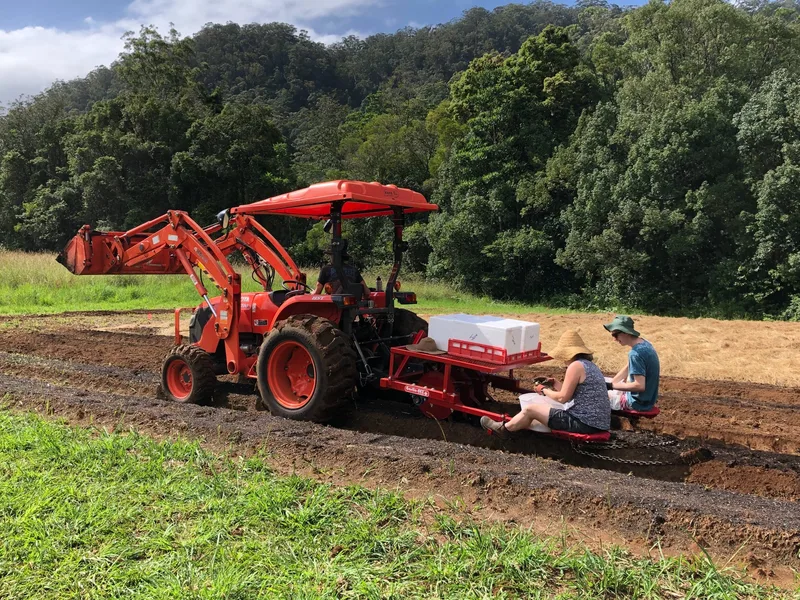 When to plant garlic in Ontario: a fall timeline Roughly two to four weeks before the ground freezes — mid-October to early November across most of the province. Here is the whole season, week by week.
 -
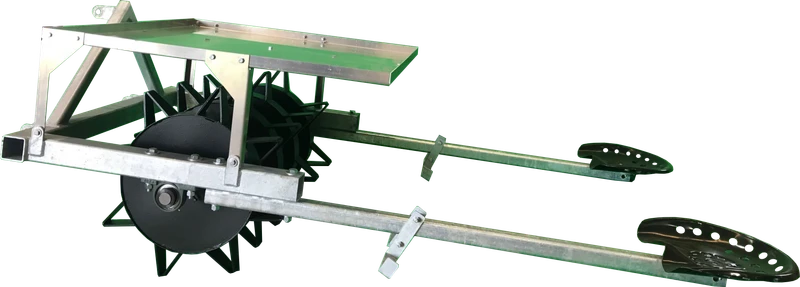 Planting onion sets with a garlic planter Sets and cloves are the same problem: a small bulb, root plate down, at a spacing. We make a dedicated onion wheel. Seed and transplants are a different machine entirely.
 - Planting tulips, hops and ginseng with a garlic planter A garlic planter is really a bulb, rhizome and large-seed planter. Six confirmed crops beyond garlic — plus the honest note that garlic is what it is optimised for.