Planting tulips, hops and ginseng with a garlic planter
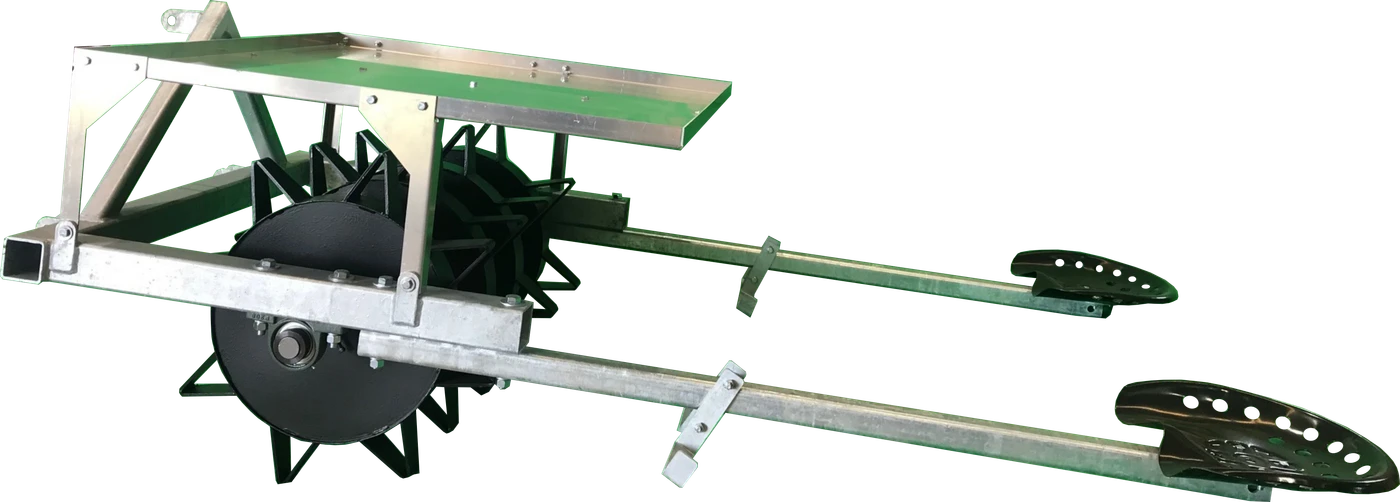
Short answer: yes. The PL-22 plants tulips, ginseng, hops, turmeric, squash and cucumbers as well as garlic. Potatoes work too, but need an adaptation to the machine. What it is really built for is any crop planted from a clove, bulb, set, rhizome or large seed, placed by hand at a set spacing and depth.
The name says garlic because garlic is what it was designed around. The mechanism is more general than the name.
Why the machine transfers
Strip the PL-22 down to what it actually does and there is nothing garlic-specific about it. It:
- opens a furrow at a set depth,
- holds row-to-row spacing across the bed,
- meters in-row spacing through the planting wheels,
- carries two seated people who place one planting unit at each station,
- closes the row behind.
Nothing in that list cares whether the thing in the rider’s hand is a garlic clove or a tulip bulb. Which is exactly why the crops that work are the crops that share garlic’s planting problem: a lumpy, irregular planting unit that has to go in the right way up, at a consistent spacing, and that a mechanical metering system handles badly.
The confirmed crops
These are crops we have seen work, or that a customer has told us about directly. If it is not on this list, we have not confirmed it — see the end of this article.
| Crop | Planting unit | Notes |
|---|---|---|
| Garlic | Clove | What the machine was designed for |
| Tulips | Bulb | Planted the same way as garlic |
| Ginseng | Root / seed | |
| Hops | Rhizome | |
| Turmeric | Rhizome | |
| Squash | Seed | |
| Cucumbers | Seed | |
| Potatoes | Seed piece | Needs an adaptation to the machine — talk to us first |
Row-to-row spacing is adjustable. In-row spacing is set by the planting wheels, which are made to your spacing — so if you are running two crops at genuinely different in-row spacings, that is a conversation to have before the machine is built, not after. Changing in-row spacing later means a different set of wheels, not a lever.
Tulips and cut-flower farms
Tulips are the closest analogue to garlic on the list, and the transfer is almost exact. A bulb, root plate down, placed at a spacing, in a bed, in the autumn.
Flower farms hit the same wall garlic growers do, on the same calendar. Tulips go in during a narrow window in the fall, the planting unit is expensive relative to the area it occupies, and the whole job is people on their knees for two weeks. If you are planting tens of thousands of bulbs by hand and losing your crew to it, the constraint you have is the constraint the PL-22 was built for.
The other thing that transfers is orientation. A tulip bulb planted sideways or inverted comes up crooked, the same way a garlic clove does. A person placing each bulb sorts that; a cup-and-belt planter does not. We wrote about why orientation matters more than raw speed for garlic, and the argument is the same for bulbs generally.
Hops, ginseng and turmeric
Rhizomes and roots share the awkward-geometry problem. A hop rhizome is a length of irregular root with buds along it; turmeric is a knuckled hand. Neither of these is something a mechanical metering cup grips reliably, and both benefit from a person deciding which way the piece lies in the furrow.
Ginseng and hops also sit in a useful economic bracket. They are high-value perennial or semi-perennial plantings where establishment quality determines returns for years, not months. Getting a hop yard planted evenly and at a consistent depth is worth more than getting it planted fast.
We list these as verified because growers of them have used the machine. What we do not have is planting-rate data by crop. The 600–800 per rider per hour figure we publish is a garlic number, and we are not going to restate it as a tulip number or a hop number because we have not measured those.
Squash, cucumbers and potatoes
Squash and cucumbers are large seed. The value here is precision placement at a wide spacing on prepared beds, rather than throughput — these are crops where you plant far fewer units per acre than garlic and each one matters.
Potatoes are the one entry on the list with an asterisk, and it is a real one. Potatoes need an adaptation to the machine. A seed piece is bigger, wetter and more fragile than a clove, and the standard configuration does not simply handle it. That is not a small footnote — it means a phone call before you order, so we know what you are planting when the machine is built. Do not order a standard PL-22 planning to run potatoes through it.
What doesn’t transfer
Three things, stated plainly.
Garlic is what it is optimised for. Every design decision — the wheel spacing options, the furrow geometry, the seat and tray layout, the pace the whole thing runs at — was made for cloves. The other crops work; they were not the design brief. On any given crop there may well be a purpose-built planter that beats it, and if you are planting one crop at scale and nothing else, go and look at those first.
The undercutter is a garlic tool. The UC-36 and UC-48 are specified for lifting garlic at 6 to 8 inches below the bulb. Whether that geometry suits potatoes, onions or any other lifted crop is a question we have not answered, and we are not going to guess. Ask; the answer may be “we don’t know yet.”
We only claim what we have confirmed. Shallots and onion sets are the obvious next question — they are small bulbs, planted like garlic, and it would be easy to add them to the list. We have not verified them, so they are not on it. If you are planting either and want to try, tell us and we will tell you what we actually know, which right now is not much.
The honest fit test
The machine makes sense for you if:
- your planting unit is a clove, bulb, set, rhizome or large seed,
- orientation or precise placement affects what you harvest,
- you are planting enough that hand-placing is a genuine labour bottleneck,
- and you are in roughly the one-to-twenty-acre band where a semi-automatic machine beats both a crew on their knees and a fully automated planter.
If you are under an acre of anything, plant it by hand. The hand-planting comparison shows where that line falls and does not flatter us in the process.
The full crops list is on the site, and the PL-22 specifications are there too. For anything not on the confirmed list, call Doug on 519-379-6210 or email doug@velocityfarmequipment.com — the answer will be what we know, including when that is nothing.
Keep reading
-
 When to plant garlic in Ontario: a fall timeline Roughly two to four weeks before the ground freezes — mid-October to early November across most of the province. Here is the whole season, week by week.
 -
 Planting onion sets with a garlic planter Sets and cloves are the same problem: a small bulb, root plate down, at a spacing. We make a dedicated onion wheel. Seed and transplants are a different machine entirely.
 -
 How to harvest garlic without breaking the necks Snapped necks are a soil problem, not a technique problem. Undercutting loosens the root mass so bulbs lift clean — and in light sand you may not need it at all.