Planting onion sets with a garlic planter
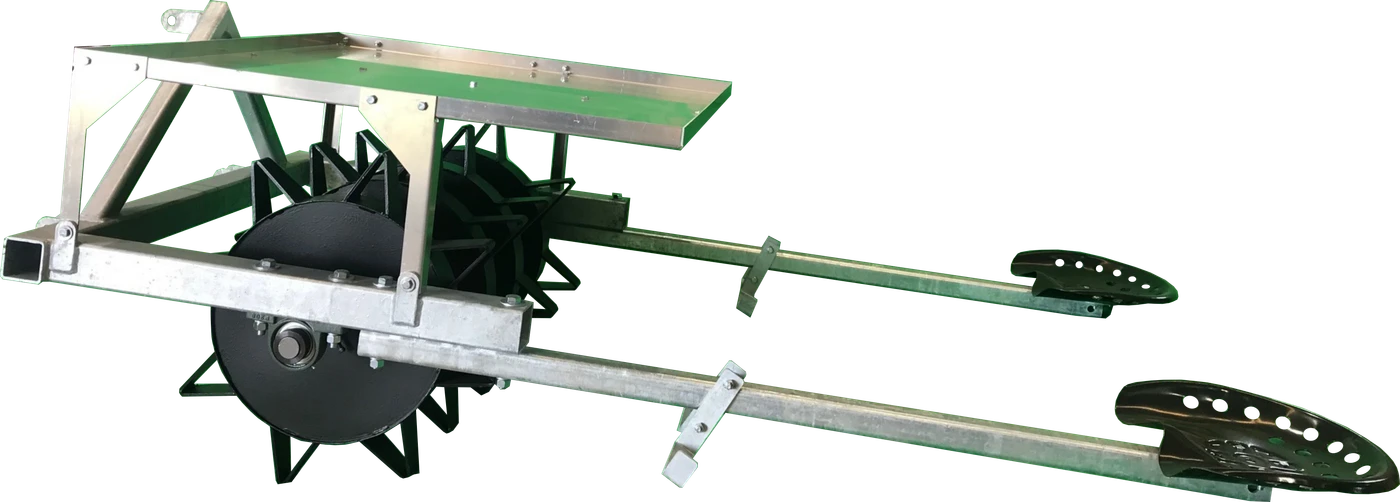
Short answer: yes, if you are planting sets. An onion set is a small bulb that goes in root plate down at a spacing, which is the same problem a garlic clove presents, and we build a dedicated onion planting wheel for it. If you are planting onion seed or transplants, this is the wrong machine.
That distinction is the whole article, so it is worth getting straight before anything else.
Sets, seed and transplants are three different jobs
Growers say “planting onions” to mean three quite different operations, and equipment that handles one may be useless for another.
| What you’re planting | What it is | Does the PL-22 handle it? |
|---|---|---|
| Sets | Small immature bulbs, roughly 1–2 cm | Yes — this is what the onion wheel is for |
| Seed | Small dry seed, thousands per ounce | No — that needs precision seed metering |
| Transplants | Seedlings with roots and tops | No — that needs a transplanter |
A machine built around placing a bulb into an opened row cannot meter seed, and it has nowhere to hold a seedling’s leaves. Nobody should sell you one on the promise that it does all three.
Sets, though, are genuinely the same problem as garlic. Both are a small bulb with a basal plate that wants to face down, planted at a fixed spacing in an opened row and covered. That is what this machine was designed to do.
The wheel is what changes
In-row spacing on the PL-22 is set by the planting wheels — pegs spaced around a rim, which open the row at fixed intervals as the machine rolls. The spacing between pegs is your in-row spacing.
That has two consequences worth understanding before you order.
Onions want a different wheel than garlic. Garlic growers commonly run 4″ to 8″ in-row. Onion sets typically go closer than that. Different spacing, different peg count, different wheel — which is exactly why we build one specifically for onions rather than telling you to make do.
You cannot dial spacing in later. Row-to-row spacing is adjustable on the machine. In-row spacing is not — it is a property of the wheel. Changing it means a different set of wheels, not a turn of a wrench. So tell us what you are planting and at what spacing before we build, and if you intend to run both garlic and onions, say so at the quote stage.
What we know and what we don’t
We build the onion wheel and it works. Here is where our knowledge stops, stated plainly rather than papered over:
- We have not published a planting rate for onions. The 600–800 cloves per rider per hour figure is a garlic number, measured planting garlic. Sets are a different size and handle differently. We are not going to restate a garlic figure with an onion label on it.
- We have not confirmed shallots. Shallots plant much like sets and it would be reasonable to expect them to work, but nobody has told us they have done it, so we do not claim it. If you try it, we would genuinely like to hear how it went.
- We have not tested the undercutter on onions. The UC series lifts garlic well. Onions sit differently in the ground and we have not run it, so we will not tell you it works.
If any of those matter to your decision, call and ask — you will get “we don’t know” where that is the true answer.
When a machine is not worth it
The same arithmetic applies as with garlic: it comes down to what your crew achieves by hand versus what two riders achieve seated, and how many people you can actually find in your area at planting time.
Under about an acre, hand-planting sets is a hard week rather than a project, and the machine will take a long time to pay for itself. Above that, the question becomes less about the wage bill and more about whether the crew exists. Run your own numbers — the calculator defaults to break-even rather than to a figure that flatters us.
And if onions are a small sideline next to a main garlic crop, the honest advice is to spec the machine for the garlic and treat onions as the bonus.
Where to start
Tell us your bed width, your row centres, your in-row spacing for each crop you want to plant, and your tractor. We build to that.
Or call Doug on 519-379-6210 and describe what you are trying to do.
Keep reading
-
 When to plant garlic in Ontario: a fall timeline Roughly two to four weeks before the ground freezes — mid-October to early November across most of the province. Here is the whole season, week by week.
 -
 Planting tulips, hops and ginseng with a garlic planter A garlic planter is really a bulb, rhizome and large-seed planter. Six confirmed crops beyond garlic — plus the honest note that garlic is what it is optimised for.
 -
 How to harvest garlic without breaking the necks Snapped necks are a soil problem, not a technique problem. Undercutting loosens the root mass so bulbs lift clean — and in light sand you may not need it at all.