What size tractor do you need for a garlic planter?
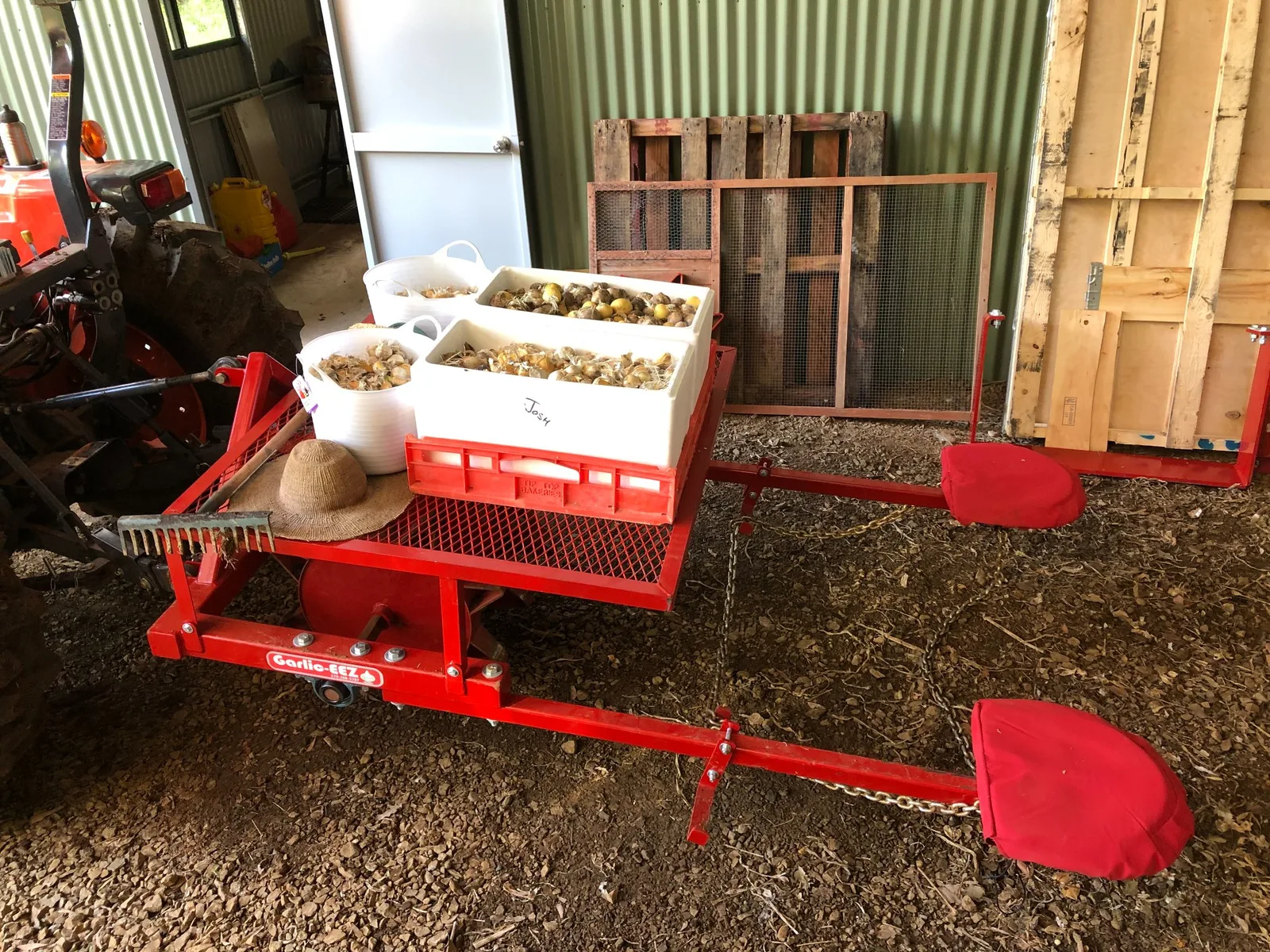
Short answer: for planting, tractor size is not really a constraint. Anything that can lift the planter on a Category 1 three-point hitch will pull it. The horsepower requirement shows up at the other end of the season — the UC undercutters need at least 40 HP.
Most people ask this question in the wrong order. They budget horsepower for planting day, buy a tractor sized for it, and then discover in July that the machine they need for harvest is the one with the real draft requirement.
Why planting takes so little
A planter is a light-draft implement. The PL-22 weighs roughly 500 lb, and the work it does in the soil is opening a shallow furrow and closing it again. There is no deep tillage, no subsoiling, no blade being dragged through undisturbed ground.
The load is almost entirely vertical: your three-point has to pick 500 lb up off the headland and hold it. Add two riders and their seed trays and you are still well inside what a small utility tractor lifts without complaint.
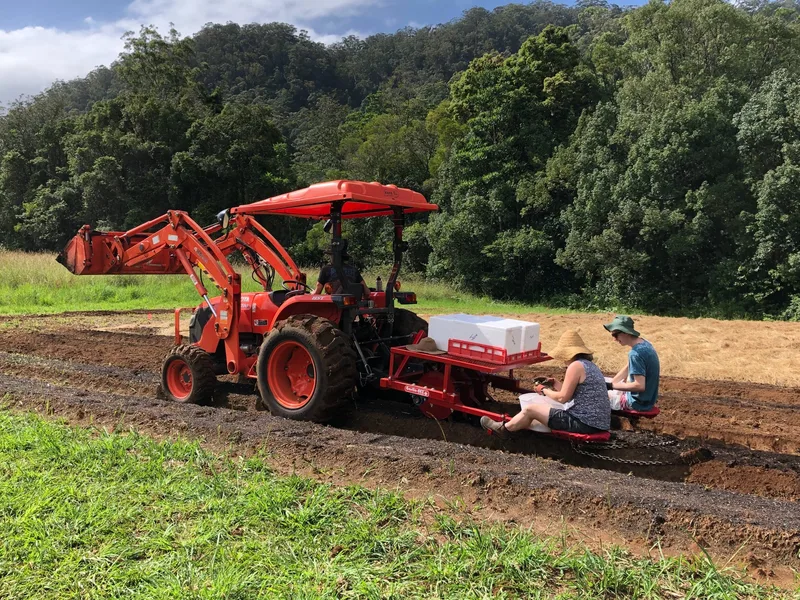
Ground speed is slow anyway. The riders are placing cloves at 600 to 800 each per hour, which sets the pace — not the tractor. A bigger engine does not make the row go in faster, because the people are the metering system.
So the specification we publish for the PL-22 is no practical minimum HP for planting. That is not marketing softness. It is what the machine asks for.
Category 1 is the real specification
The number that matters for planting is not horsepower. It is hitch category.
| Hitch category | Typical tractor range | Lower link pin | Top link pin |
|---|---|---|---|
| Cat 0 | Sub-compact / garden | 5/8″ | 5/8″ |
| Cat 1 | Compact and utility, roughly 20–45 HP | 7/8″ | 3/4″ |
| Cat 2 | Utility and row-crop, roughly 40–100 HP | 1 1/8″ | 1″ |
The PL-22 mounts to a standard Category 1 three-point hitch. If your tractor has Cat 1 lower links, the planter goes on. If it is a Cat 0 sub-compact, it does not without adaptation. If it is a Cat 2 tractor, you can usually fit Cat 1 bushings and reducer pins to step down — a common, cheap conversion, but check yours before you order rather than after the crate arrives.
Two other things to confirm on your own tractor, both of which have nothing to do with horsepower:
- Lift capacity at the ball ends. Published lift capacities are often quoted at the hitch point, not out at the end of the links where the load actually sits. You want headroom over 500 lb, not a number that just barely covers it.
- Rear wheel spacing. The planter is 48″ wide assembled and works over your beds. If your rear track is set wider than your bed centres, you will be driving on the ground you just planted.
Where the horsepower requirement actually lives
Harvest.
The UC-36 and UC-48 undercutters run a blade 6 to 8 inches below the bulb and pull it through the full width of the bed. That is draft load, and draft load is what sizes a tractor.
The undercutter itself weighs about 100 lb — a fifth of the planter. It is the lightest implement on the farm and the one with the highest horsepower requirement, which is exactly the fact that catches people out. The minimum is 40 HP, and the reason has nothing to do with picking the thing up.
| PL-22 planter | UC-36 / UC-48 undercutter | |
|---|---|---|
| Weight | ~500 lb | ~100 lb |
| Load type | Lift (vertical) | Draft (horizontal) |
| Minimum HP | No practical minimum | 40 HP |
| Hitch | Category 1 | Mounts to the PL-22 frame |
Note that last row, because it changes what you have to own. The undercutter is not a separate implement. It mounts to the PL-22 frame in place of the planting wheels — you take the wheels off and put the blade on. You need a planter to run one. If you already have an older Garlic-EEZ planter, that works too; we still support those machines.
The buying order most people should use
- Decide whether you will undercut at harvest. If yes, your tractor requirement is 40 HP, full stop, and planting is a non-issue.
- If you are only planting for now, size for Cat 1 and lift capacity, and be honest with yourself that adding an undercutter later means revisiting the tractor.
- Check hitch category and rear track width before anything else.
A 25 HP compact with a Cat 1 hitch is a perfectly good planting tractor. It is not a harvest tractor.
Where this advice runs out
Three honest limits.
Minimum HP is not the same as comfortable HP. Forty is the number for pulling the blade through the bed. Heavy clay, a dry season that has set the ground up hard, or a slope will all ask for more than a machine sitting exactly at the minimum can give. If your soil is heavy and you are choosing between 40 and 50 HP, choose 50 — and call before you buy, because we would rather talk through your soil than sell you a blade that stalls in it.
If you already own a 40 HP-plus tractor, none of this is a decision. You are covered at both ends of the season and the question is closed. Don’t overthink it.
Do not buy a tractor to buy a planter. If the honest sum is “the planter costs X and the tractor to run the undercutter costs 4X”, the machine is not solving your problem this year. Work out whether planting labour is even your bottleneck first — the hand-planting comparison shows the case where a planter saves nothing at all, and the labour cost calculator will run it for your acreage.
What we can’t tell you from a web page
Whether your specific tractor is right for your specific field. Slope, soil type, bed layout and wheel track all matter, and none of them are on a spec sheet.
Call Doug on 519-379-6210 with your tractor model and your bed dimensions. He built the machines, and he will tell you if the answer is no.
More detail on the machines themselves: the PL-22 planter, the undercutters, and the FAQ.
Keep reading
-
 When to plant garlic in Ontario: a fall timeline Roughly two to four weeks before the ground freezes — mid-October to early November across most of the province. Here is the whole season, week by week.
 -
 Planting onion sets with a garlic planter Sets and cloves are the same problem: a small bulb, root plate down, at a spacing. We make a dedicated onion wheel. Seed and transplants are a different machine entirely.
 - Planting tulips, hops and ginseng with a garlic planter A garlic planter is really a bulb, rhizome and large-seed planter. Six confirmed crops beyond garlic — plus the honest note that garlic is what it is optimised for.