Garlic yield per acre: how to measure your own
Short answer: garlic yield per acre is plant population multiplied by average marketable bulb weight, and both halves are specific to your farm. We do not publish a yield figure, because we do not have one worth publishing — we build planters, we do not run yield trials. What we can give you is the arithmetic and a sampling method that produces a real number for your ground in about two hours of work.
If you came here hoping for a pounds-per-acre figure for a business plan, the honest advice is to distrust any single number you find, including one you might have found here. Yield swings enormously with variety, spacing, soil, fertility, moisture, season and how the crop is graded.
The identity everything rests on
yield per acre = plants harvested per acre × average marketable bulb weightThat is trivially true and it is useful precisely because it splits the problem into two things you can each measure independently.
Plants harvested per acre is your planted population multiplied by your establishment rate. Planted population is pure geometry — an acre is 6,272,640 square inches, so cloves per acre is 6,272,640 divided by (in-row spacing × between-row spacing). The full chart is in how many garlic cloves per acre.
Average marketable bulb weight is the part nobody can tell you. It is set by variety, by competition at your spacing, by fertility and by the season. It is also the number that moves most between farms.
Working in row-feet instead of square inches
For field sampling, row-feet is a more convenient unit than square inches, because a tape measure down a row is how you will actually take a sample.
row-feet per acre = 43,560 ÷ (row spacing in feet)
plants per row-foot = 12 ÷ (in-row spacing in inches)| Row centres | Row-feet per acre |
|---|---|
| 6″ | 87,120 |
| 8″ | 65,340 |
| 10″ | 52,272 |
| 12″ | 43,560 |
| 18″ | 29,040 |
| 24″ | 21,780 |
| 30″ | 17,424 |
The two methods agree, as they must. At 6″ in-row on 8″ centres: 65,340 row-feet × 2 plants per foot = 130,680 plants per acre, which is the same as 6,272,640 ÷ 48.
Beds with pathways. If you plant beds separated by unplanted paths, count only the planted ground. A 4-foot bed with a 2-foot path is 4 feet planted in every 6, so multiply by 0.67. Growers comparing yields who have not made this adjustment are frequently comparing numbers a third apart for no agronomic reason at all.
Method one: the pre-harvest estimate
Do this a week or two before lifting, when bulbs have largely sized. It is an estimate, not a measurement, and it is for planning curing space, labour and sales — not for your records.
- Pick five locations that fairly represent the field. Not the headland, not the best patch, not the wet corner. If the field is variable, sample the zones separately and weight them by area.
- At each, measure off a fixed length of row — 10 or 20 feet — and count every plant still standing. This gives plants per row-foot as grown, not as planted.
- Lift five representative plants from each location, trim as you would for sale, and weigh them together. Divide by five for average bulb weight.
- Average across your five locations, then:
estimated lb per acre = (average plants per row-foot)
                      × (row-feet per acre)
                      × (average bulb weight in lb)
A worked illustration, with numbers I have invented purely to show the arithmetic. Suppose 6″ in-row on 8″ centres, so 65,340 row-feet per acre. Suppose your counts average 2 plants per row-foot and your sample bulbs average 2 ounces, which is 0.125 lb. Then 65,340 × 2 × 0.125 = 16,335 lb per acre for that hypothetical field. Every input there is made up. Substitute your own and the arithmetic holds; borrow mine and you have learned nothing.
Method two: the post-harvest measurement
This is the one that goes in your records, and it is worth doing properly once rather than approximately every year.
- Mark measured strips before you lift. Flag a known length of row — 20 feet is convenient — in three to five places. Do this before the undercutter goes through, because afterwards you cannot tell where a row started.
- Count what you planted, if you can. If you kept a note of cloves per bed at planting, you can calculate establishment rate: bulbs harvested divided by cloves planted. That single ratio is one of the most informative numbers on a garlic farm.
- Keep the strips separate through curing. Bag or crate them with a label. This is the step people skip and it is the step that makes the whole exercise valid.
- Weigh at a stated moisture state. Weigh cured, after trimming, graded the way you sell. If you weigh green out of the field you will get a much larger number and it will not be comparable to anything.
- Record the grade split: marketable, seed grade, and culls, weighed separately.
lb per acre = (lb from the strip ÷ length of strip in feet) × row-feet per acreWorked with invented numbers again: a 20-foot strip yields 5.1 lb of cured, trimmed, marketable garlic. That is 0.255 lb per row-foot. On 8″ centres, 0.255 × 65,340 = 16,662 lb per acre. Again — my 5.1 lb is fictional. Yours will not be.
Green weight versus cured weight
The single largest source of confusion in garlic yield figures is that people quote different things and call them the same.
| Weight quoted | What it includes | Comparable to |
|---|---|---|
| Field or green weight | Full moisture, tops, roots, soil | Almost nothing else |
| Cured, untrimmed | Cured, tops and roots still on | Other untrimmed cured figures |
| Cured, trimmed, all grades | Saleable condition, culls included | Total farm output |
| Cured, trimmed, marketable only | What you actually sell at grade | Revenue planning |
Garlic loses substantial weight during curing, and how much depends on your curing conditions and how long you cure. Always state which of these you are quoting, in your own records and when you tell anyone else. A yield figure without a moisture state attached is not a figure. What good curing looks like is in curing and storing garlic.
What to do with the number once you have it
Three things, in order of usefulness.
Compare it against itself. The same field, the same method, year over year, is the most valuable comparison available to you and the only one fully under your control.
Break it into its two halves. If yield fell, was it population or bulb size? A drop in population points at establishment — seed quality, planting depth, winter kill, or cloves going in the wrong way up, covered in clove orientation and yield. A drop in average bulb size points at competition, fertility or moisture, and spacing is the lever there — see the spacing guide.
Use it to plan the physical crop, not just the money. Bulb count drives curing surface, handling trips and grading hours, all of which are per-bulb and none of which scale kindly.
Limitations, stated plainly
- We publish no yield figures and this page contains none. Every number in the worked examples is invented to demonstrate arithmetic. Do not quote them, and be sceptical of anyone who quotes a single figure at you as though yield were a constant.
- We run no yield trials. Velocity builds planters and undercutters in Dundalk, Ontario. Agronomic performance is outside what we measure, and we will not imply otherwise by putting a plausible-looking number on a page.
- Sampling has real error. Five strips in a variable field will not give you a precise answer. If your fields differ meaningfully, sample them as separate fields.
- One season proves little. Weather dominates year-to-year variation. Three seasons of consistent method is where the number starts to mean something.
- This method assumes an even stand. In a field with large gaps or patchy loss, strip sampling misleads badly, because you will either sample the gaps or avoid them. Whole-block weighing is the only honest approach there.
If you want somebody’s number to check your own against, ask two or three growers in your county on similar soil growing the same variety — and ask which of the four weight definitions above they are using. That question alone will improve the comparison more than any published average.
Keep reading
-
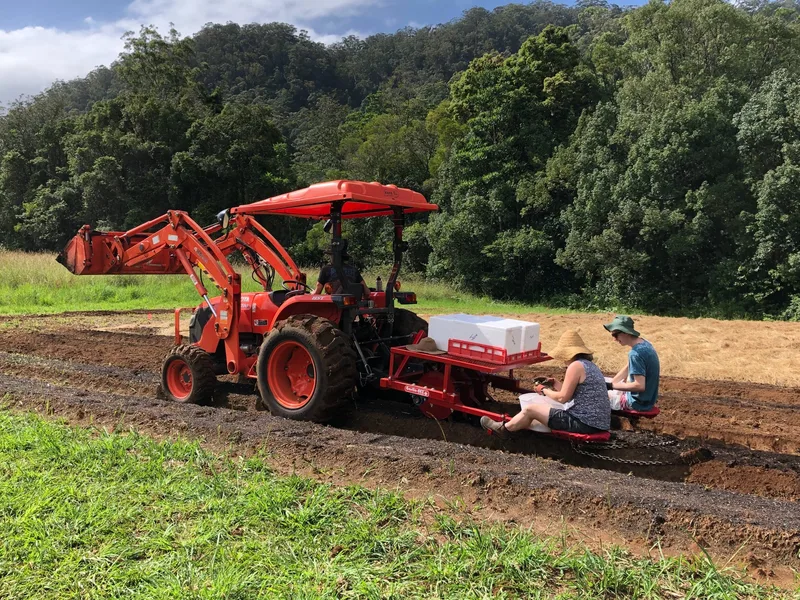 When to plant garlic in Ontario: a fall timeline Roughly two to four weeks before the ground freezes — mid-October to early November across most of the province. Here is the whole season, week by week.
 -
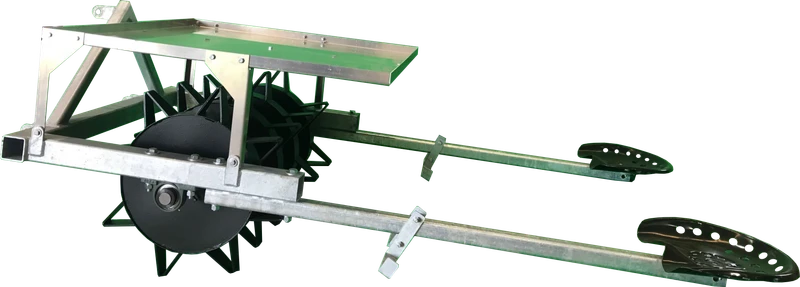 Planting onion sets with a garlic planter Sets and cloves are the same problem: a small bulb, root plate down, at a spacing. We make a dedicated onion wheel. Seed and transplants are a different machine entirely.
 - Planting tulips, hops and ginseng with a garlic planter A garlic planter is really a bulb, rhizome and large-seed planter. Six confirmed crops beyond garlic — plus the honest note that garlic is what it is optimised for.