Garlic plant spacing: how close is too close?
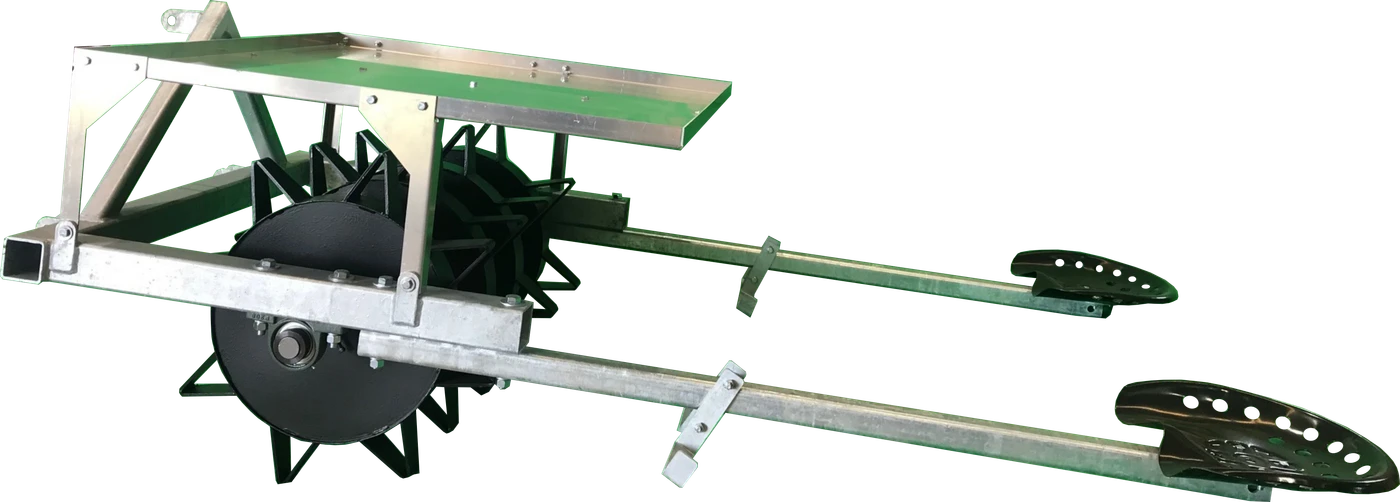
Short answer: most growers land between 4 and 8 inches in-row and between 6 and 12 inches between rows. Closer in-row raises plant count and lowers average bulb size; wider between rows costs you plants but buys you the ability to cultivate. There is no universally correct spacing, but there is a correct one for your market, your soil and your weed strategy.
The thing worth understanding is that spacing is not a single decision. It is two decisions, they pull in different directions, and on a ride-on planter they are not equally easy to change afterwards.
The two spacings do different jobs
In-row spacing — the distance between one clove and the next along the row — principally sets competition between neighbouring plants and therefore average bulb size.
Between-row spacing — the distance between row centres — principally sets what equipment can physically travel down the field, and therefore what your options are for weeds, side-dressing and harvest.
Growers who treat them as one number (“I plant on six-inch centres”) usually end up optimising one and accepting whatever the other gives them.
What the arithmetic says
Cloves per acre is fixed by geometry. An acre is 43,560 square feet, or 6,272,640 square inches, so:
cloves per acre = 6,272,640 ÷ (in-row spacing × between-row spacing)| Layout (in-row × between-row) | Square inches per plant | Cloves per acre | Machine-hours at 1,400/hr |
|---|---|---|---|
| 4″ × 6″ | 24 | 261,360 | 187 |
| 5″ × 6″ | 30 | 209,088 | 149 |
| 4″ × 8″ | 32 | 196,020 | 140 |
| 6″ × 6″ | 36 | 174,240 | 124 |
| 6″ × 8″ | 48 | 130,680 | 93 |
| 6″ × 10″ | 60 | 104,544 | 75 |
| 8″ × 8″ | 64 | 98,010 | 70 |
| 8″ × 12″ | 96 | 65,340 | 47 |
The last column uses the middle of the PL-22 range — two riders at 600 to 800 cloves each per hour, so 1,200 to 1,600 for the machine, with a third person driving the tractor — and it is there to make one point: the gap between 4″ × 6″ and 8″ × 12″ is a four-fold difference in seed, in planting time and in every per-bulb operation for the rest of the season. Spacing is the largest single lever you have over the labour cost of a garlic crop.
Full workings and a per-pound method for converting cloves into seed weight are in how many garlic cloves per acre.
Beds with pathways need adjusting. The table assumes solid planting. If you run 4-foot beds with 2-foot paths, only 4 feet in every 6 is planted, so multiply the acre figure by 0.67. A grower quoting “6 × 6” on a bed system and a grower quoting “6 × 6” solid-planted are describing populations a third apart.
In-row spacing and bulb size
The general relationship is unsurprising and consistent: as plants get closer together they compete for water, nutrients and light, and average bulb size falls. Total yield per acre often rises as you tighten spacing — more, smaller bulbs — but it rises less than proportionally, and past a point it stops rising at all.
Which side of that trade you want depends entirely on what you are selling.
| If you are selling into | You probably want | Because |
|---|---|---|
| Farmers’ market, retail by the bulb | Wider in-row | Buyers pick the big bulb off the table; small bulbs move slowly at any price |
| Seed garlic | Wider in-row | Seed grades on bulb and clove size, and premium grades pay for it |
| Wholesale by weight | Tighter in-row | Total weight per acre is what you get paid on |
| Processing, peeled or paste | Tighter in-row | Size grade matters little once it is peeled |
Two cautions. First, variety changes the answer — a large-cloved hardneck and a tight-cloved softneck do not respond identically to the same spacing, so settle your variety before you settle your spacing. Second, soil fertility and moisture-holding capacity move the point at which competition starts to bite, which is why a spacing that works on a neighbour’s sandy loam may not work on your clay.
Between-row spacing and everything else
Between-row spacing gets decided by weed strategy far more often than by agronomy.
The blunt version: a cultivator has to fit. Whatever tool you intend to run between the rows — a wheel hoe, a tine weeder, a tractor-mounted cultivator with sweeps — has a minimum working width and needs clearance either side of the plants. Choose the tool first and let it set the row spacing, not the other way around. The full argument, with what fits at what width, is in weed control in garlic.
The other consideration is airflow. Tighter rows hold humidity in the canopy for longer, which matters in a wet spring and in regions where foliar disease is a live concern. It is a real effect and a secondary one compared with weeds.
What this means for machine configuration
Here is where spacing stops being agronomy and becomes a purchasing decision, and it catches people out.
On the PL-22, in-row spacing is set by the planting wheels. The wheels are made to your spacing, and changing your in-row spacing later means a different set of wheels — it is not an adjustment you make with a wrench in the yard.
Row-to-row spacing is adjustable on the machine. Row count and bed width are configured to your beds before the machine ships, and the row-to-row setting can be moved afterwards.
| Decision | When it is fixed | How to change it later |
|---|---|---|
| In-row spacing | At build, by the wheel configuration | A different set of wheels |
| Row-to-row spacing | Configured at build | Adjustable on the machine |
| Row count and bed width | Configured to your beds before shipping | Talk to us |
The practical consequence: spend your thinking time on in-row spacing before you order. Between-row you can revisit. In-row you are committing to, and the commitment lasts as long as the wheels do.
If you genuinely do not know yet — and plenty of growers do not, particularly if they are changing market or changing variety — say so at the quote stage rather than picking a number to be decisive. Lead time is 1 to 2 weeks plus shipping, so there is room to have the conversation properly. The PL-22 specifications list what gets configured and what does not.
Where this guidance does not apply
- We publish no yield figures, and none of the above should be read as one. The direction of the size-versus-count trade is well established; the magnitude on your farm is not something we know. Measure it — the method is in garlic yield per acre.
- We have not tested spacing effects ourselves. Velocity builds planters. The agronomy on this page is standard horticultural knowledge, not our trial work, and your provincial specialist or a local grower with ten years of records on your soil type is a better source than we are.
- Trial before you convert a whole farm. The cheapest way to settle a spacing argument is to plant two blocks at two spacings in the same field, keep everything else identical, and weigh them separately at harvest. One season of that beats any table, including ours.
- Changing your mind later is a set of wheels, not a new machine. If your market or variety changes and you want a different in-row spacing, that means planting wheels made to the new spacing; row-to-row you adjust on the machine itself. The frame stays the same, at one acre or as your acreage grows.
If you want to talk it through against a specific bed layout, ring 519-379-6210 with your bed width, your row centres and what you are selling into. That last one usually decides it.
Keep reading
-
 Garlic crop rotation: what to grow between and how long to wait Rotation is cheap disease control that only works if the break is real: long enough, free of allium volunteers, and not planted to a crop that hosts the same pests.
 -
 When to cut garlic scapes, and why it matters Scaping is a June labour pass that protects bulb size, and it produces the first thing a garlic farm has to sell all year. When to do it, how, and what the scapes are worth to you.
 -
 How to sell garlic: the five channels compared Every garlic channel trades price against volume and your time. How the five main ones compare, and why seed garlic pays best and carries the most responsibility.