Garlic bloat nematode: how to spot it and keep it out
Short answer: garlic bloat nematode (Ditylenchus dipsaci) is a microscopic roundworm that feeds inside the stem and bulb, and it arrives on almost every farm the same way — in infested seed garlic. There is no rescue treatment once a crop is infested. Control is clean seed, long rotation, and not carrying soil from a bad block into a good one.
That is the hard part of this topic, so it goes first. Bloat nematode is not a spray problem. By the time you can see it, the damage is done for that season, and the only decisions left are about what you save for seed and where you plant next year.
What it actually is
Bloat nematode is a plant-parasitic roundworm about a millimetre long, invisible without a microscope. It is not an insect and not a fungus, and it does not behave like either.
It feeds inside plant tissue rather than on the surface. A population enters through the basal plate or the leaf sheaths, multiplies within the stem and bulb scales, and breaks down the cell walls as it goes. What you eventually see — the soft, discoloured basal plate, the crumbling bulb — is the aftermath of feeding that started well before harvest.
Two properties make it awkward in garlic:
- It survives desiccation. Bloat nematode can enter a dormant, dried-out state and persist for years in dry plant debris, in cull piles and in stored bulbs.
- It travels in the thing you plant. Cloves cut from an infested bulb carry live nematodes into clean ground. This is the dominant spread route, ahead of soil, water and equipment.
Identifying it in the field and in the bulb
Symptoms are stage-dependent, and none of the early ones are unique to nematode. This is what to look for and when.
| Stage | What you see | How specific is it? |
|---|---|---|
| Early growth | Stunting, patchy stands, yellowing or twisting of the lower leaves | Low — frost, poor drainage and fertility all look similar |
| Mid-season | Swollen, distorted or bloated stem bases; leaves splaying oddly | Moderate — worth investigating |
| Approaching harvest | Early senescence in patches, not evenly across the field | Moderate |
| At lifting | Roots sparse or gone; basal plate soft, brown, spongy or separating from the bulb | High |
| In storage | Bulbs light for their size; scales dry and shredding; secondary rots taking hold | High |
The pattern matters as much as the symptom. Nematode damage usually shows up in patches that follow how the field was worked or how the seed was laid out, rather than as an even decline across the whole block. A patch that maps onto a single seed lot is a strong signal.
Cut the bulbs. The most useful diagnostic you can do on your own farm is to lift a dozen suspect plants, slice each bulb vertically through the basal plate, and compare against healthy plants from elsewhere in the field. A sound plate is firm and pale with roots attached. An infested one is soft, discoloured and often lifting away in layers.
Getting a real diagnosis
Cutting bulbs tells you something is wrong. It does not tell you what — several bulb rots produce a soft basal plate, and the management for each differs.
Send a sample to a provincial or university plant health lab, which will extract and identify nematodes from bulb tissue and from soil. Send whole affected plants with soil still on the roots, plus a few healthy ones for comparison, and label which block and which seed lot each came from. A result naming the species and the population is worth far more than a season of guessing.
Why clean seed is the whole game
If bloat nematode principally moves in seed, then seed sourcing is your main control, and everything else is damage limitation.
Practically, that means:
- Ask, in writing, whether the lot has been tested, and for the result. A grower who tests will tell you. A grower who bristles at the question has told you something too.
- Do not save seed from a block with any suspicion of infestation. This is the most common way a farm infests itself permanently, and it is a false economy that outlasts the decision by a decade.
- Keep seed lots separate and traceable through planting, so that if a problem shows up you can tell which lot did it. Note the lot against the block on a map. It costs five minutes in October and it is the only way to learn anything the following July.
- Quarantine new seed. Plant an unfamiliar lot in an isolated block for a season before it goes anywhere near your main ground or your seed stock.
Hot water treatment of seed cloves is an established practice for reducing nematode populations, but the effective temperature and duration windows are narrow, the margin between treating the nematode and killing the seed is small, and results vary. Get the current protocol from your provincial specialist and trial it on a small quantity of your own seed first. We are equipment builders, not a seed lab, and we are not going to publish a temperature we have not validated.
Sanitation: rotation, hosts and soil movement
Once nematode is present in a field, three things determine how long it stays a problem.
Rotation length. Bloat nematode persists in soil without a host, so short rotations do very little. Long rotations out of alliums — several years, not one — are what draw populations down, and exactly how long depends on your population level and your soil, which is again an argument for a lab number.
Alternative hosts. The species has a wide host range that includes common weeds and some cover and field crops. A rotation is only a break if the rotation crop and the weeds in it are not hosts. Check host status rather than assuming “not garlic” means “not a host”.
Soil movement. Nematodes move centimetres on their own. They move fields on tyres, boots, tillage tools and implements. The order you work your fields is free control: do the clean blocks first and the suspect block last, then knock the soil off before anything goes back in the shed.
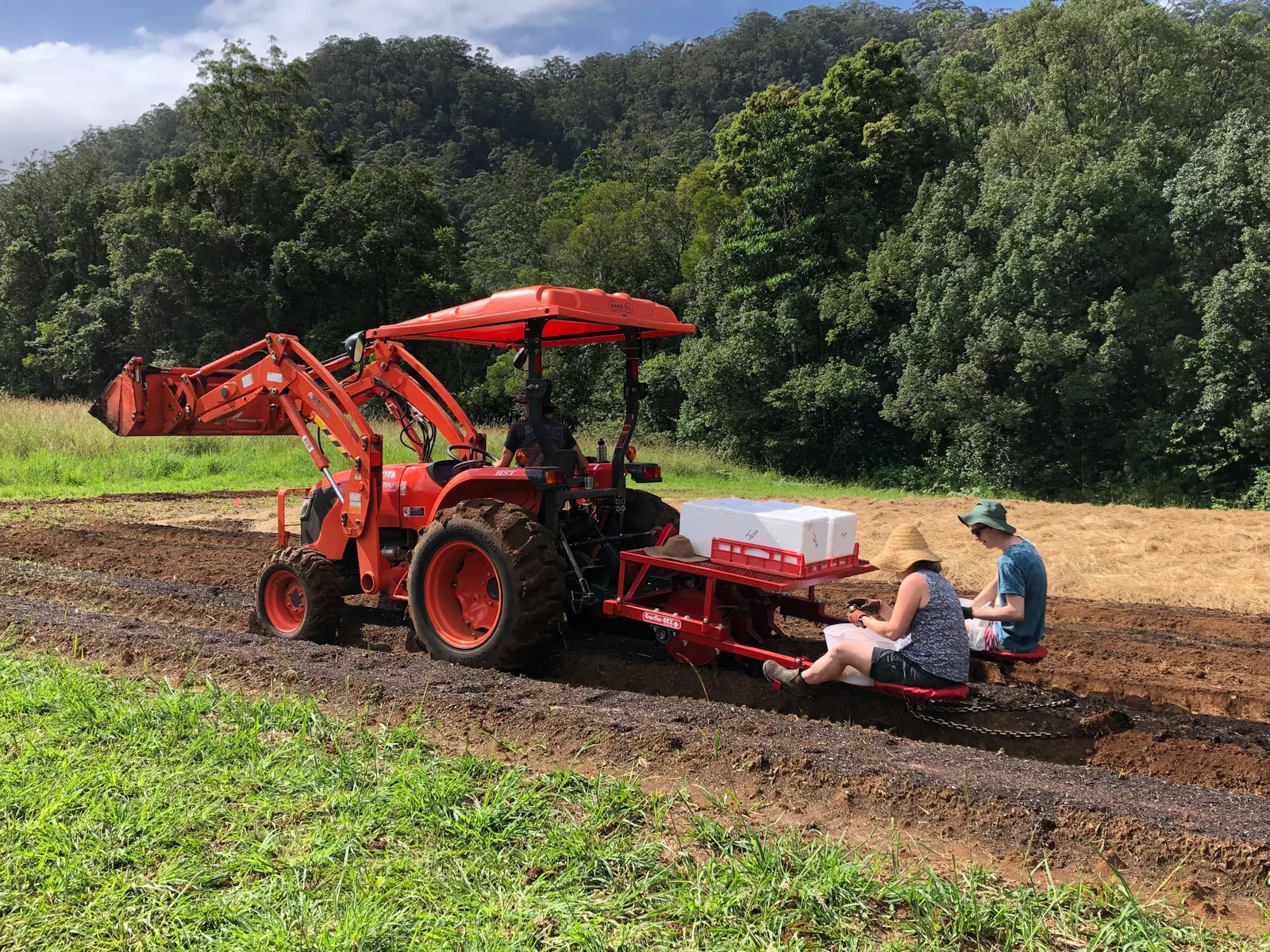
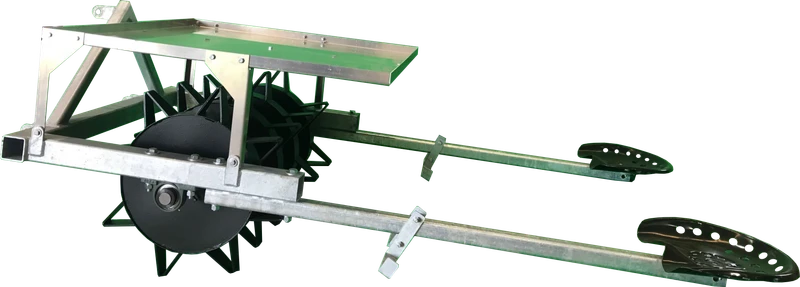
That applies to planting equipment as much as tillage. Our PL-22 runs wheels through the soil in every row; the UC-36 and UC-48 undercutters run a blade 6 to 8 inches below the bulb and lift the whole bed. Both move soil, and both should be knocked down and blown off between blocks. There is no clever design feature here — it is a scraper, a brush and ten minutes.
One genuine advantage of a hand-fed planter is at the tray rather than in the field. Because a person places every clove on the PL-22, a rider sees each one and can throw a soft clove on the ground instead of in the row. A fully automated planter meters whatever you feed it. That is not a control measure — culling visibly bad cloves does not make a lot clean — but it is one more chance to catch a lot you should not have cracked.
Where we are no help
- We sell no treatment, and no machine controls nematode. Nothing on this site reduces a population. Our contribution is a cleanable frame and the advice to work the clean fields first.
- We have not published thresholds. What population constitutes an economic problem in your soil type is a question for your provincial specialist with your lab report in hand. We will not invent a number.
- This is general horticultural knowledge, not our research. The biology above is standard published material on Ditylenchus dipsaci. Treat your own lab result and your specialist’s advice as authoritative over anything on this page.
- If your symptoms are even, not patchy, look elsewhere first. Uniform stunting across a whole block is more often drainage, planting depth, cold injury or fertility. Start with the cheaper explanations.
What to do this season
If you suspect it: cut bulbs, send a sample, map the affected patches against your seed lots, and do not save seed from anywhere near the problem.
If you do not: the work is still seed sourcing and record-keeping, which is the same decision covered in choosing seed garlic. How the crop comes out of the ground, and how much soil comes with it, is in undercutting at harvest.
The growers who stay clean are the ones who know which lot went in which block, and who will not plant seed they cannot vouch for.
Keep reading
-
 When to plant garlic in Ontario: a fall timeline Roughly two to four weeks before the ground freezes — mid-October to early November across most of the province. Here is the whole season, week by week.
 -
 Planting onion sets with a garlic planter Sets and cloves are the same problem: a small bulb, root plate down, at a spacing. We make a dedicated onion wheel. Seed and transplants are a different machine entirely.
 - Planting tulips, hops and ginseng with a garlic planter A garlic planter is really a bulb, rhizome and large-seed planter. Six confirmed crops beyond garlic — plus the honest note that garlic is what it is optimised for.