Buying a used garlic planter: what to inspect
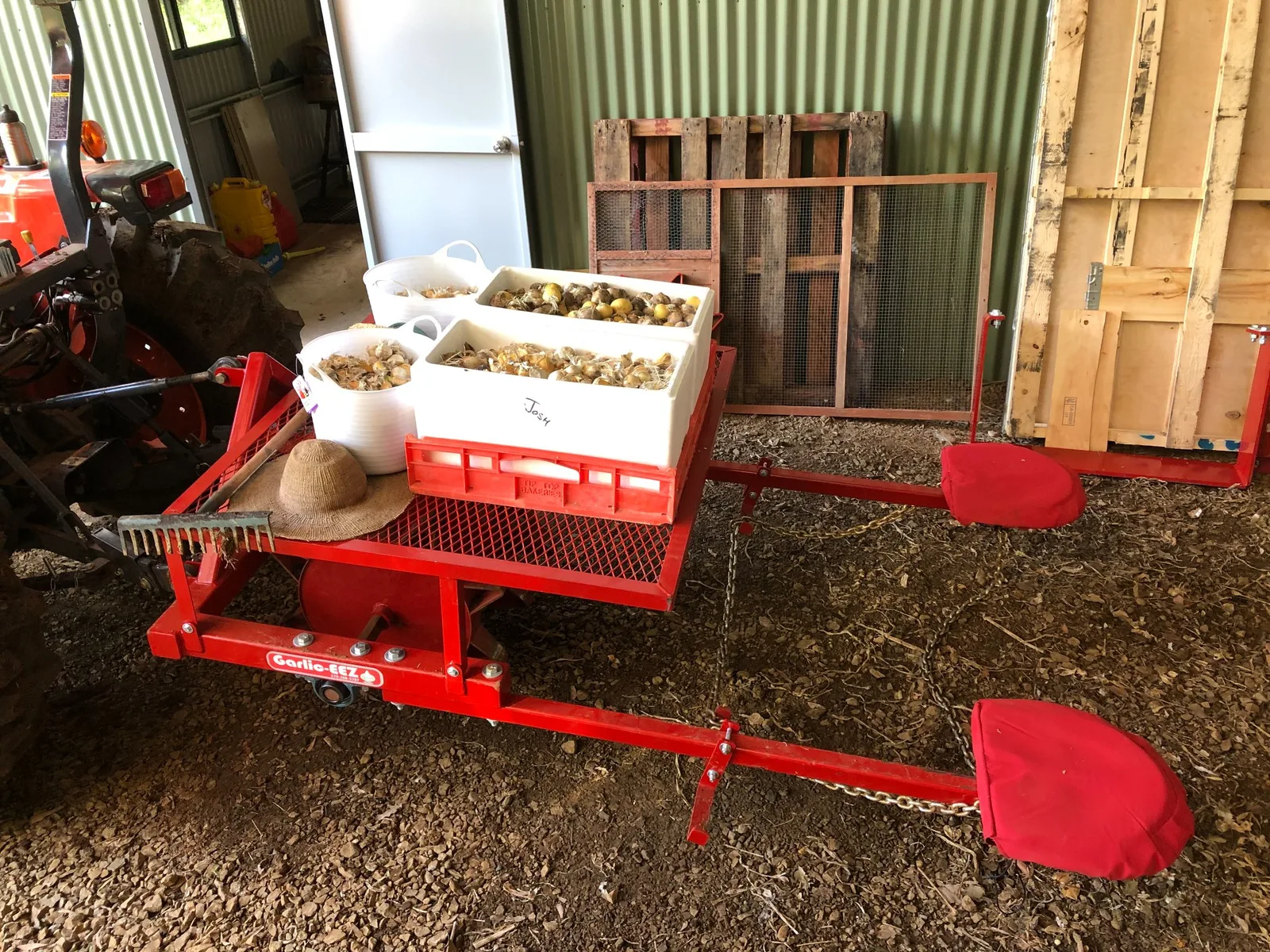
Short answer: check the frame and welds, the planting wheels, the bearings and the hitch — but the specification that decides whether the machine suits your farm is the in-row spacing built into its wheels, because that is not adjustable. And if the used machine you have found is a Garlic-EEZ, that is a reasonable thing to buy. We built those, and we still support them.
We are an equipment manufacturer telling you it is fine to buy second-hand, which deserves an explanation. Garlic planters are a small market. Machines come up rarely, and a grower who finds one at the right spacing at the right time of year should not talk themselves out of it on our account. We would rather you got the crop in.
Why a used Garlic-EEZ specifically is a sensible buy
Velocity Farm Equipment builds the machines that were sold under the Garlic-EEZ name from 2016 to 2022. Doug Gilbert designed and fabricated those planters and undercutters, and took the operation over under the new name in early 2022 — same shop, same address in Dundalk, Ontario, same machines.
The practical consequences for a second-hand buyer are the ones that usually make or break a used equipment purchase:
- Parts exist. We still support machines built under the Garlic-EEZ name. Call 519-379-6210 with your unit details. Full detail is on the Garlic-EEZ parts and service page.
- The person who answers the phone built it. Not a dealer network reading a parts book for a discontinued brand.
- Undercutters usually retrofit. The UC-36 and UC-48 mount in place of the planting wheels. On an older Garlic-EEZ planter that is normally straightforward, but ring with your planter details so the fit gets confirmed before you order rather than after.
That is a genuinely unusual position for a used farm machine. A great many second-hand implements are orphans the day the brand stops trading.
The inspection
Take an hour over this. Bring a torch, a tape measure and something to kneel on.
| Area | What to look at | Why it matters |
|---|---|---|
| Frame and welds | Cracks at the joints, especially around the hitch A-frame and the seat rails; previous repair welds; bends from something being dropped or dragged | The frame is the machine. A cracked weld is repairable; a twisted frame throws every row out |
| Corrosion | Surface rust versus pitting or flaking; the underside of the toolbar; anywhere soil sits | These frames are galvanised steel. Surface marks are cosmetic, section loss is not |
| Planting wheels | Peg spacing (measure it, do not take the seller’s word), bent or missing pegs, wear at the peg roots, run-out when the wheel is spun | Peg spacing is your in-row spacing. See below |
| Bearings and pivots | Play in the wheel bearings, dry or seized pivots, elongated bolt holes | Cheap to fix, but tells you how the machine was stored |
| Furrow openers and closers | Wear on the leading edges, alignment, whether adjusters still move | Worn openers give inconsistent depth, which shows up as uneven emergence |
| Seed trays | Cracks, missing hardware, mounting points | Riders work off these all day. Awkward trays cost you rate |
| Seats and rails | Secure mounting, safe footing, condition of the rails | Two people ride this machine at working height behind a tractor |
| Hitch | Category 1 pins, pin holes for wear, top link point | The PL-22 mounts to a standard Category 1 three-point hitch |
| Row-to-row adjusters | Whether they still slide and clamp, or have seized in position | Row-to-row spacing is meant to be adjustable. If it is seized, budget for freeing it |
Two practical additions. Ask to see it work, or at minimum see it hitched and lifted on a tractor. And ask about soil hygiene — where the machine has worked and whether it has been cleaned. A planter that has run in a block with a soil-borne problem is a way to import that problem, which is one of the routes covered in garlic bloat nematode. Pressure-wash anything used before it touches your ground.
The spec that actually decides it
Here is the point that matters more than any amount of rust.
In-row spacing is set by the planting wheels, and it is not adjustable. The wheels are made to a spacing. Changing that spacing means a different set of wheels, not a turn of a wrench. So a used machine built for a grower who plants at 4 inches is a 4-inch machine until you buy wheels.
Row-to-row spacing is adjustable, and row count and bed width are configured before a machine ships. So a used machine’s row layout is more forgiving than its in-row spacing.
| What you are buying | Adjustable after purchase? | If it is wrong |
|---|---|---|
| In-row spacing | No — set by the wheels | New wheels, made to your spacing |
| Row-to-row spacing | Yes | Adjust it on the machine |
| Row count / bed width | Configured at build | Talk to us about what is possible |
| Hitch category | Category 1, standard | Check your tractor matches |
So before you drive four hours to look at a machine, ask the seller to measure the peg spacing on the wheels and the row centres. If the in-row spacing is not what you plant at, that is not a deal-breaker — it is a line item, and you should price the wheels into the offer rather than discovering them in October. Work out what spacing you actually want first: the trade-offs are in the spacing guide.
What you give up buying used
Straightforwardly, so you can price it:
- No warranty. A new machine carries one year. A used one carries whatever the seller says, which is usually nothing.
- It is not configured to your beds. A new build is made to your bed width, row centres and in-row spacing. A used machine is made to somebody else’s.
- Lead time is not much of an argument. New machines are 1 to 2 weeks to build, plus shipping. If you are buying used mainly to avoid a long wait, the wait is shorter than people assume — order well ahead of your planting window and there is plenty of room.
- Freight may still apply. These crate down for freight and ship worldwide, but a private seller three provinces away is a freight bill you arrange yourself.
Against that, a used machine at the right spacing costs less and is available now. That is a real advantage and it is often the deciding one.
Where this advice runs out
- We cannot value a specific used machine for you. We do not track second-hand prices, we have no listing service, and we are not going to invent a fair number. Pricing on new machines is a phone call — every machine is built to the grower’s configuration, so there is no list price — and used pricing is between you and the seller.
- We do not broker or inspect. There is no Velocity certified-used programme. We can tell you whether a part exists and whether an undercutter will fit; we cannot tell you whether that particular machine in that particular yard is sound.
- This covers ride-on planters we know. Nothing here transfers to fully automated cup or belt planters, which fail in different places and are outside what we build.
- If you are under about an acre, do not buy a planter at all — used or new. It is a hard week by hand and no machine pays back against that. The cost calculator defaults to break-even rather than to a figure that flatters us, and it will tell you when the answer is no.
If you have just bought one
Ring 519-379-6210 with the unit details before your first season, not during it. Tell us what you have, what spacing it is built to and what spacing you want, and whether you plan to add an undercutter. Sorting wheels or a retrofit in the spring is a conversation. Sorting them in the second week of October is a problem.
Keep reading
-
 When to plant garlic in Ontario: a fall timeline Roughly two to four weeks before the ground freezes — mid-October to early November across most of the province. Here is the whole season, week by week.
 -
 Planting onion sets with a garlic planter Sets and cloves are the same problem: a small bulb, root plate down, at a spacing. We make a dedicated onion wheel. Seed and transplants are a different machine entirely.
 - Planting tulips, hops and ginseng with a garlic planter A garlic planter is really a bulb, rhizome and large-seed planter. Six confirmed crops beyond garlic — plus the honest note that garlic is what it is optimised for.